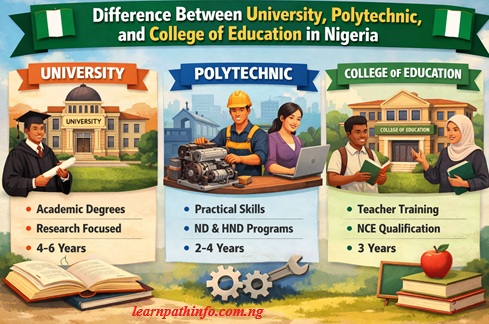
Difference Between University, Polytechnic, and College of Education in Nigeria
Difference Between University, Polytechnic, and College of Education in Nigeria; Choosing the right path after secondary school is one of the most important decisions a student will ever make. In Nigeria, this decision often comes with confusion because there are three major tertiary education routes: Universities, Polytechnics, and Colleges of Education.
Many students and parents hear these names but do not fully understand what makes each one different, what certificates they award, or how they affect future career opportunities. As a result, some students end up in institutions that do not align with their goals, strengths, or long-term plans.
Off course their exist plethora of schools in the country with their standards and curriculums, students may find it confusing to make their choice. This become a setback if not properly looked into
Before rounding up from the high school, it is very important to understand the differences in these higher institutions of learning, more so, students will know and understand which is which and how to process their admission and many more
This guide explains in clear and practical terms the real differences between universities, polytechnics, and colleges of education in Nigeria, helping students and parents make informed decisions.
Overview of Nigeria’s Tertiary Education System
Nigeria’s tertiary education system is structured to cater to different career paths and learning styles. Each institution type has a defined purpose:
Universities focus on academic and professional education.
Polytechnics emphasize technical and practical skills.
Colleges of Education specialize in training teachers.
All three are regulated by different government bodies and award different qualifications. Understanding this structure is the first step to choosing correctly.
Key Differences at a Glance
| Feature | University | Polytechnic | College of Education |
| Focus | Academic & research | Practical & technical | Teacher training |
| Regulator | NUC | NBTE | NCCE |
| Certificate | Degree | ND / HND | NCE |
| Duration | 4–6 years | ~5 years (with IT) | 3 years |
| Learning style | Theoretical | Hands-on | Pedagogical |
| Career focus | Professional fields | Technical industries | Teaching |
What Is a College of Education in Nigeria?
A College of Education is a specialized institution created to train teachers for Nigeria’s education system. These colleges are regulated by the National Commission for Colleges of Education (NCCE).
Key Characteristics of Colleges of Education
- Focused on teaching and pedagogy
- Curriculum centered on education and subject specialization
- Practical teaching experience through teaching practice
Certificates Awarded
Colleges of Education award:
- Nigeria Certificate in Education (NCE)
Duration of Study
- Typically 3 years
Admission Requirements
- UTME
- Lower cut-off marks than universities and polytechnics
Who Should Choose a College of Education?
This path is best for students who:
- Have a passion for teaching
- Want to work in primary or secondary schools
- Plan to further their education later through Direct Entry
- Prefer shorter study duration
What Is a Polytechnic in Nigeria?
A polytechnic is a tertiary institution focused on technical, vocational, and practical education. Polytechnics are regulated by the National Board for Technical Education (NBTE).
They are designed to produce graduates who are job-ready, especially in technical and industrial sectors.
Key Characteristics of Polytechnics
- Strong emphasis on practical skills
- Hands-on training and workshops
- Industry-oriented curriculum
- Less theoretical than universities
Certificates Awarded by Polytechnics
Polytechnics award:
- National Diploma (ND)
- Higher National Diploma (HND)
Duration of Study
- ND: 2 years
- Mandatory Industrial Training (IT): 1 year
- HND: 2 years
Total: approximately 5 years including IT
Admission Requirements
- UTME for ND
- Lower cut-off marks compared to universities
- Direct Entry available for HND holders
Who Should Choose a Polytechnic?
Polytechnics are suitable for students who:
- Prefer practical learning
- Want technical or vocational careers
- Plan to work in industries like engineering, ICT, manufacturing, or design
- Learn better through hands-on experience
What Is a University in Nigeria?
A university is a higher institution designed to provide academic, professional, and research-based education. Universities in Nigeria can be federal, state, or private, and they are regulated by the National Universities Commission (NUC).
Key Characteristics of Universities
- Longer duration of study
- Greater recognition for professional careers
- Strong emphasis on theory, research, and academic knowledge
- Broader range of courses and disciplines
Certificates Awarded by Universities
Universities award:
- Doctorate degrees (PhD)
- Bachelor’s degrees (BSc, BA, BEng, LLB, etc.)
- Master’s degrees (MSc, MA, MBA, etc.)
Duration of Study
- Most bachelor’s degree programs last 4 years
- Professional courses like Medicine, Law, or Engineering may last 5–6 years
Admission Requirements
- UTME (JAMB)
- Post-UTME screening
- Generally higher cut-off marks compared to other institutions
Who Should Choose a University?
Universities are ideal for students who:
- Plan to pursue postgraduate studies
- Want broader career flexibility Enjoy academic learning and research
- Aim for professional careers (law, medicine, engineering, academia)
Career Opportunities After Graduation
University Graduates
- Corporate jobs
- Professional practice
- Postgraduate education
- Research and academia
Polytechnic Graduates
- Technical and industrial roles
- Entrepreneurship
- Skilled trades and technology fields
College of Education Graduates
- Teaching in schools
- Education administration
- Further studies via Direct Entry
Can You Switch Between These Institutions?
Yes. Nigeria’s education system allows mobility:
- NCE holders can gain Direct Entry into universities
- ND/HND holders can also enter universities
- Polytechnic graduates can pursue postgraduate degrees
However, the transition may require:
- Additional qualifications
- Bridging programs
- Longer study time
Common Myths Students Believe on the Difference Between University, Polytechnic, and College of Education in Nigeria
Myth 1: Polytechnic graduates are inferior
This is false. Polytechnic graduates are often more practically skilled.
Myth 2: Colleges of Education are only for weak students
Teaching requires skill, patience, and training. It is a professional career.
Myth 3: University is always the best choice
The “best” choice depends on career goals, not public opinion.
How to Choose the Right One for You
Parents should also:
- Respect the student’s interests
- Avoid comparing children unfairly
- Focus on long-term success, not prestige
Ask yourself:
- Do I prefer theory or practice?
- What career do I want?
- How long am I willing to study?
- What are my academic strengths?
Final Thoughts
Universities, polytechnics, and colleges of education each play important roles in Nigeria’s development. None is inherently better than the other — they are simply different paths designed for different goals.
The key to success is choosing the path that aligns with your abilities, interests, and long-term plans. When students make informed decisions, they are more likely to succeed, regardless of the institution they attend.
It is very important to understand the dynamics of these three wonderful higher institutions and the roles they play, this is not the sole responsibility of students alone but the family and society at large, by so doing, informed and healthy choices are made and students are happy at the completion of their program
Difference Between University, Polytechnic, and College of Education in Nigeria